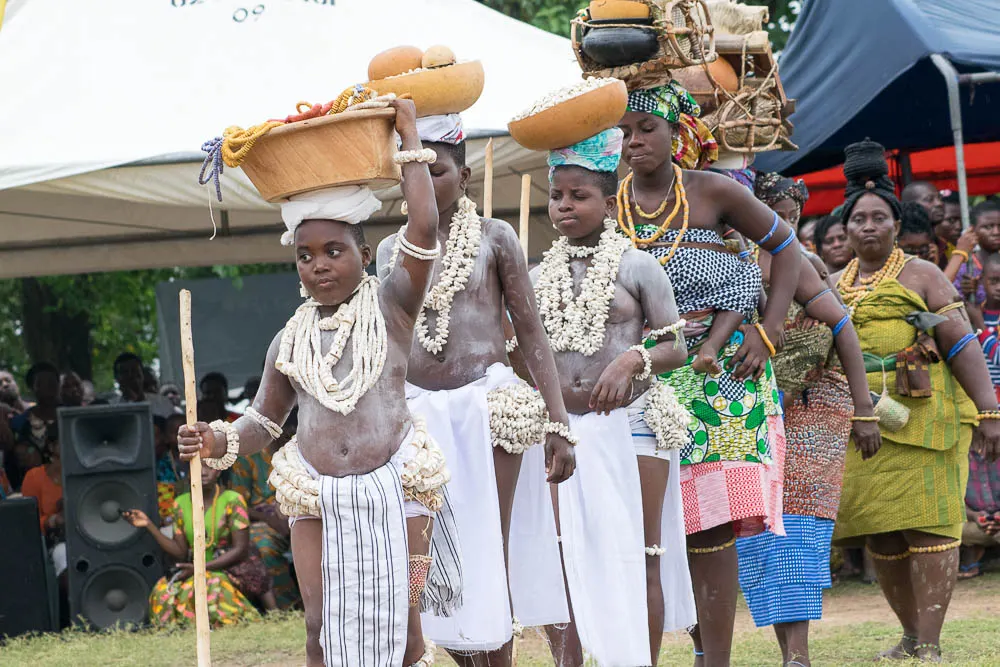
The escape from Notsie
At Notsie the Ewe lived under Togbi Agorkoli, who made his people build a great wall round the town and executed anyone who tried to leave. When he ordered them to make rope from clay, Togbi Tegli outwitted him by asking for a sample to copy.1
The people planned their escape. Women poured water on one stretch of the wall night after night to soften it, and an all-night session of drumming and dancing kept the king at ease. In the dark Tegli pierced the wet wall with a dagger, and the people walked out backwards, so their tracks looked as though they were coming in, not leaving.12
The name is usually explained from three Ewe words: ho, to move, gbe, day, and tsotso, crossing over.2
What happens
- Before
- Saturday
Good to know if you go
- Where: Anloga is on the strip between the sea and the Keta lagoon, about three hours east of Accra.
- Stay nearby: Keta and Anloga are small; book ahead for the festival weekend.
- Respect the rites: some rituals are sacred and not for cameras. Ask before photographing chiefs, priests or anyone taking part, and follow what the ushers ask.
- Related: Aflao remembers the same escape at Godigbeza.
Questions people ask
What is Hogbetsotso?
The festival of the Anlo Ewe people, remembering their ancestors’ escape from King Agorkoli’s rule at Notsie, in present-day Togo.
When is Hogbetsotso celebrated?
Usually on the first Saturday of November, with the grand durbar at Anloga.
Why did the Anlo walk backwards?
So their footprints would look as if they were entering Notsie, misleading the king’s soldiers.
Sources
- Alberto Mario Noretti, “Hogbetsotso Za: exodus of the Anlo people from Notsie”, Graphic Online, 11 November 2022.
- “Hogbetsotso festival”, Wikipedia.
Last checked 16 October 2026. Spotted something wrong or know this year’s dates? Tell us.